
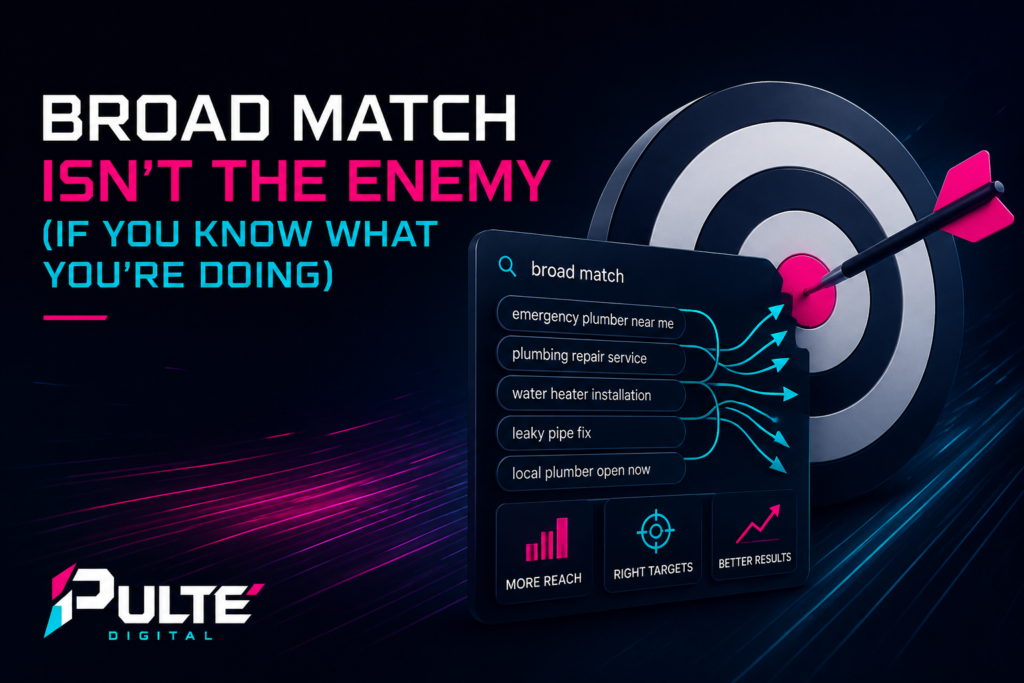
Broad match has a reputation problem. For years it was the match type that burned budgets, triggered irrelevant searches, and made account managers look bad in client calls. That reputation was earned.
However, since then, the technology behind broad match has changed significantly. Many users’ understanding of it hasn’t.
What changed
Google no longer matches keywords based on the words themselves. The system evaluates meaning, context, and intent. When deciding whether to show your ad, it weighs search history, browsing behavior, audience data, device, and time of day.
That’s the shift. Broad match stopped being “related keywords” and became intent modeling at scale. When the account conditions support it, broad match surfaces queries that no manually built keyword list would ever find.
The numbers back this up. An Adalysis study across 16,825 search campaigns found that broad match delivers the highest revenue per conversion of any match type when paired with value-based Smart Bidding — despite often carrying a higher CPA. Search Engine Land’s coverage of the study put it plainly: accounts that judged performance on CPA alone missed the revenue upside entirely.
One more thing worth knowing now: starting in September 2026, Google will automatically upgrade campaigns using the campaign-level broad match setting to AI Max. If you’re running broad match at the campaign level, that change is coming regardless of whether you plan for it.
The three conditions
Broad match without the right account foundation is still a budget fire. The accounts where it performs share three things.
Strong conversion tracking. Call tracking, form tracking, ecommerce events. Google needs to know what a conversion looks like before it can optimize toward one.
Sufficient volume. At least 50 to 100 conversions per month. Below that threshold, the algorithm doesn’t have enough data to steer reliably, and the cost of its learning process comes out of your campaign budget.
A built-out negative keyword list. The irrelevant traffic common to your industry should already be blocked before broad match goes live. Adding negatives reactively after broad match is running is damage control, not strategy. Miss any one of these and broad match will educate Google’s AI at your expense.
How to introduce it without chaos
The right approach is layered, not a full account conversion.
Start with exact match as your foundation. Lock in your highest-intent, proven keywords and protect them with their own campaign and tighter CPA or ROAS targets. This is your profit anchor. It runs regardless of what you’re testing elsewhere.
Layer broad match in a separate campaign as a discovery tool. Review the search terms report weekly. Filter for high-impression, zero-conversion terms and add negatives without hesitation.
When broad match surfaces a query driving 10 to 20 conversions at strong ROAS, pull it into your exact match campaign and give it its own bid rules. That is the actual workflow. Broad match finds traffic. Exact match locks in the wins. The two campaigns work together, not against each other.
What the data says about all three match types
From the Adalysis study of 16,825 campaigns:
Exact match converts 40% of interactions into conversions while accounting for 27% of total impressions — the best conversion-to-impression ratio of the three. Non-negotiable for high-intent terms and brand keywords.
Phrase match generates 24% of conversions and 35% of revenue, but its position is increasingly uncomfortable. Google expanded phrase match behavior significantly in 2025, pushing it closer to broad match on one end and exact match on the other. In accounts with sufficient conversion data, the overlap often makes phrase match redundant. Check your search terms report: if the same queries are triggering both phrase and exact, drop the phrase version.
Broad match accounts for 25% of keywords and 46% of impressions. High ceiling, high risk, high dependency on Smart Bidding and negative keyword discipline.
Broadly speaking
Broad match is a graduate-level tool. It rewards accounts with clean data and punishes accounts without it.
The direction of the platform is clear. More sophisticated accounts are running broader keyword strategies with smaller lists, leaning on Smart Bidding to handle the granularity that used to require exhaustive keyword management. Google is pushing in that direction whether individual advertisers follow or not.
Keywords are becoming the input signal, not the strategy. The advertisers who understand that now will have a structural edge over the ones still building 500-keyword ad groups and calling it precision targeting.