
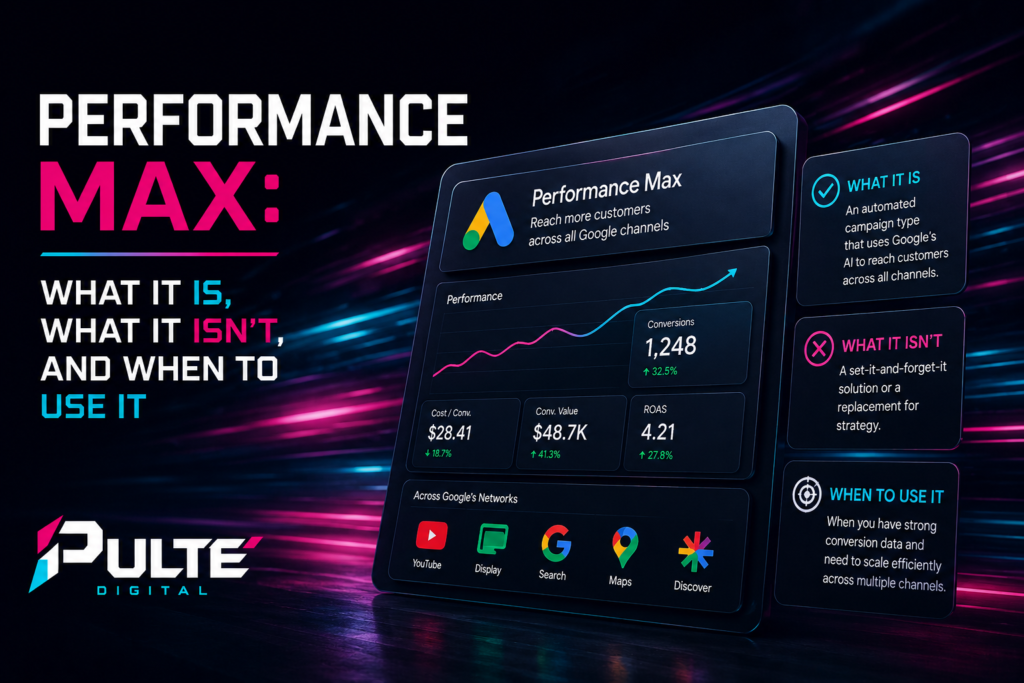
Performance Max (commonly called PMax for short) is a Google Ads campaign type that runs across every surface Google owns from a single setup. Search, Shopping, YouTube, Display, Discover, Gmail, Maps. One campaign, one budget, every placement.
Many advertisers will avoid it because they don’t understand it, are wary of the “all placements”, or run it wrong because they think it runs itself. Both are expensive mistakes.
How it works
You provide the inputs: conversion goals, creative assets (headlines, descriptions, images, videos), and audience signals. Google’s AI handles placement, bidding, and format. The same asset group can produce a text ad on Search, a video ad on YouTube, and a display ad on the network simultaneously.
There are no keyword lists and no manual placement controls. The campaign runs on asset groups, audience signals, and machine learning across Google’s full inventory.
Audience signals are worth understanding clearly. They guide the algorithm, they don’t restrict it. You’re telling Google where to start looking, not where to stop. If it finds conversion opportunity outside your signals, it will go there.
The numbers
According to Google Marketing Live 2026 data compiled by SearchLab, 72% of Google Ads advertisers now run at least one PMax campaign, and the average CPA for PMax runs 8% lower than traditional campaigns.
Google’s own internal data puts the average conversion lift at 18% versus comparable traditional campaigns at similar cost per action. Camera reseller KEH Camera reported a 76.3% increase in advertising revenue after transitioning from Standard Shopping to PMax over six months — and that was a well-configured account with strong conversion history behind it.
Those results are real. They are not what a default configuration produces.
What PMax is not
It is not a Search campaign replacement. PMax and Search can compete for the same queries. When they do, Search retains priority on exact keyword matches, while PMax captures adjacent and uncovered demand. Run them together and protect your core Search terms. Don’t pick one over the other.
It is not passive. Conversion tracking has to be set up correctly before launch. Assets need regular review. Negative keywords need active maintenance. Walk away from a PMax campaign and it will find creative ways to spend your budget on nothing useful.
It is not the right tool for every account. Accounts producing fewer than 30 conversions per month don’t give the algorithm enough signal to optimize against. At that volume, a focused Search campaign gives you more control and cleaner data to work with.
The inputs that determine performance
PMax reflects what you put into it. That sounds obvious. Most advertisers still underinvest in the inputs.
Assets. Generic images, missing video, and headline variations that all say the same thing produce weak asset ratings and weak performance. Upload variety across every format Google supports. You can even use AI to help you generate images if you don’t have any.
Video. PMax serves ads on YouTube and Discover, both of which favor video heavily. If you skip uploading your own, Google auto-generates video from your static images. Auto-generated video consistently underperforms purpose-built creative. Upload your own, if at all possible.
Conversion tracking. PMax needs conversion history to learn. Fewer than 30 conversions in the last 30 days means the algorithm is guessing. Get tracking right before the campaign goes live, not after you’re wondering why results are flat.
Starting from scratch doesn’t necessarily disqualify PMax, it just requires more patience. The algorithm will lean heavily on your audience signals and asset quality while it builds conversion data. Expect a longer learning period, keep your budget steady, and don’t touch your targets until it has at least 30 conversions to work with. The less historical data you bring in, the more the quality of your inputs determines early performance.
Negative keywords. Account-level negative keyword lists apply to PMax and are the most reliable way to block irrelevant traffic. Use the brand exclusion feature, available directly in campaign settings, to prevent the campaign from burning budget on your own brand queries. These are two separate controls. Use both.
Search themes. As of late 2024, PMax supports search themes at the asset group level. These are not keywords in the traditional sense. You’re not bidding on them or matching to them directly. Think of them as additional intent signals you’re handing the algorithm: topics, services, or queries you want it to prioritize when deciding where to show your ads. Add 8 to 12 per asset group. They work alongside your audience signals, not instead of them, and Google will tell you whether each theme is generating incremental traffic or just duplicating what the algorithm would have found anyway.
How to launch it
Start with a budget you can hold steady for two to four weeks. Tighten ROAS or CPA targets only after the algorithm has logged at least 30 to 50 conversions. Give it something to learn from before you start squeezing it.
When scaling, increase budget by roughly 20% at a time. Large budget changes reset the learning period. Make a big move and immediately pull the performance report, and the data won’t tell you anything useful. Give changes two to three weeks before drawing conclusions — that’s the window Adalysis identified across 16,825 campaigns for meaningful performance signals to emerge.
Budget for a learning phase of roughly six weeks before drawing hard conclusions. During this window, the algorithm is calibrating, testing placements, formats, audiences, and bid levels. Performance will be uneven early. Cutting the campaign or slashing budgets before the learning phase completes is the most common reason PMax gets written off prematurely.
Perform Better
PMax rewards good inputs and punishes lazy setups. The advertisers getting strong results are not the ones who handed Google the most control. They’re the ones who gave Google the best information to work with: clean tracking, strong creative, well-structured audience signals, and tight negative keyword management.
Feed it well and it will find conversion paths no manually managed campaign would uncover. Feed it nothing and it will spend your budget proving that point.