
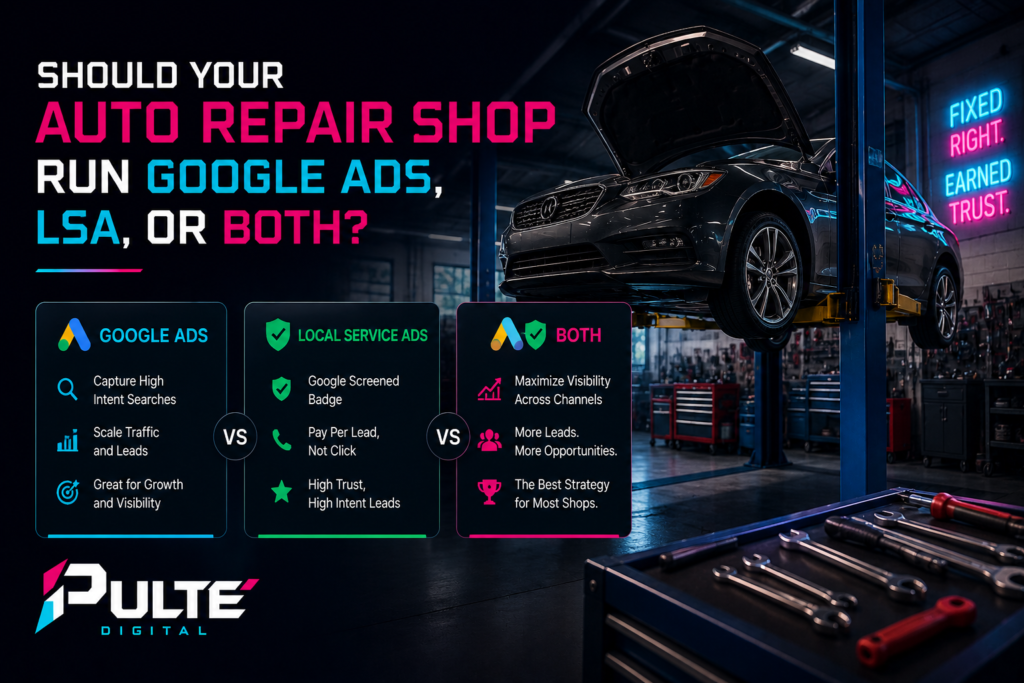
The question shop owners usually ask is “which one is better — Google Ads or Local Service Ads?” That’s the wrong question. The right one is: what kind of work are you trying to win, and which platform is built for it?
The answer determines whether you run one, the other, or both. Here’s how to think through it.
How they work differently
Google Search Ads operate on a pay-per-click model. You build keyword lists, write ad copy, set bids, and pay every time someone clicks your ad — whether they call you, book an appointment, or bounce off your site in three seconds. The targeting is precise, the control is granular, and the cost is real regardless of outcome.
Local Service Ads work differently. LSAs are pay-per-lead — you’re charged when a customer calls or messages you directly through the ad, not when someone clicks. They sit above traditional Google Ads and organic results. On mobile, they often occupy the entire first screen before anything else appears.
LSAs also carry a verification requirement. To run them, your shop goes through a screening process covering business license, insurance, and background checks. Once approved, your listing displays the Google Verified badge — a trust signal that 42% of searchers say makes them more likely to choose a provider over a competitor without it.
What each one costs
This is where the comparison gets interesting.
According to BrightLocal data, LSA leads average $161 to acquire a paying customer. Traditional Google Ads average $312 for the same result. That gap exists because Google Ads charges per click — and only 5 to 8% of clicks turn into leads. You’re funding 92 to 95% of your clicks without getting a single call back.
For auto repair specifically, LSA cost per lead for general repair work runs $18 to $23. Google Search Ads for the same category run two to three times higher. For high-volume services like oil changes, brakes, and diagnostics, the cost math tilts heavily toward LSA.
Cost per lead is only half the equation though. What matters is cost per booked job. If your shop answers the phone fast and converts leads well, LSA’s lower CPL becomes a real advantage. If you miss calls or let leads go cold, you’re paying for nothing regardless of which platform sent them.
Run LSA when you want to fill bays fast
LSA is built for one scenario: a driver with an immediate need searching for help right now. “Brake repair near me.” “Check engine light on.” “Tire shop open Sunday.” These are emergency and high-intent searches where the customer has already decided to call someone — they’re just deciding who.
Being first on that page matters. Google’s own data shows businesses in LSA results receive 25 to 30% more calls than those relying on organic listings alone for identical searches.
LSA also handles lead credits for spam, wrong numbers, and out-of-area contacts — though Google overhauled the credit system in 2025 and removed some manual dispute options. Your profile configuration matters more now than it did before. Get your service categories and geographic coverage dialed in tight before launch or you’ll pay for leads you can’t convert.
One more thing worth knowing before you set up LSA: the badge changed. In October 2025, Google replaced the Google Guaranteed and Google Screened badges with a unified Google Verified checkmark and discontinued the money-back guarantee that used to come with it. The verification requirements stayed the same. The consumer protection did not.
Run Google Search Ads when you need precision
Google Search Ads earn their place when you need targeting that LSA can’t deliver.
Want to reach BMW owners, diesel drivers, or performance car enthusiasts? LSA doesn’t let you do that. Want to run a promotion on transmission service or push a seasonal tire changeover campaign? LSA’s category structure isn’t built for it. Want to appear in surrounding markets outside your primary service area? LSA locks you to a geographic radius. Search Ads don’t.
Search Ads also pick up research-phase queries that LSA misses entirely. Someone searching “how much does a timing belt replacement cost” or “best transmission shop in [city]” isn’t ready to call yet — they’re building a shortlist. A well-built Search campaign puts your shop in front of that customer before they’ve made a decision. LSA doesn’t show up for those searches at all.
For high-ticket specialty work — engine rebuilds, suspension overhauls, custom fabrication — Search Ads give you the keyword control and landing page flexibility to attract the right customer instead of whoever calls first.
LSA ranking is not just about budget
Unlike Google Search Ads where higher bids directly buy better position, LSA ranking is driven by review count, review recency, response speed, and bid. A shop with 80 reviews from the past year outranks a shop with 300 reviews that are all three years old.
Google also tracks response behavior. Every LSA call routes through Google’s system and the algorithm monitors whether you answered, how fast, and whether the lead converted. Shops that consistently miss calls or turn away leads get deprioritized. The platform rewards businesses that close.
Before launching LSA, get your Google Business Profile to at least 10 to 15 recent reviews with a 4.0 or higher rating. Your ranking out of the gate depends on it.
The case for running both
The shops getting the best results aren’t choosing between the two. LSA and Google Search Ads serve different roles within the same search ecosystem — one captures immediate-need customers at the top of the page, the other reaches research-phase and specialty customers deeper in the funnel.
Run LSA to capture high-intent, ready-to-call traffic for general repair services. Run Search Ads to target specialty work, seasonal promotions, and customers who are still doing research. Together they cover more of the purchase journey than either one does alone.
The budget split depends on your shop’s mix. If the majority of your revenue comes from general repair, weight toward LSA. If you’re pushing specialty work or trying to grow a specific service category, Search Ads deserve more of the budget.
Start Your Engines
LSA fills bays fast with lower-cost, high-intent leads on general repair work. Google Search Ads target specific customers, specific services, and specific markets with precision LSA doesn’t offer. The shops winning on Google are running both and treating them as complementary, not competing. The ones struggling are picking one, underfunding it, and wondering why it isn’t working.
Want more cars in your shop? Get in touch and let’s talk about what’s possible for your shop.